Scroll: one particle cloud, seven projects, each shape drawn from its own data
0
Li-ion cathodes screenedDegradation Screening Index, Spearman ρ = 0.76 on 11 experimental cathodes; ChemRxiv preprint, under revision at PCCPCathodeAI →0 mV
training RMSE on my own LMO cell datathree fitted DFN parameters; the unseen 2C voltage predicted within 17 mV; the 2C loss split 74 / 17 / 6 %LMO rate model →0.0 %
wafer non-uniformity, down from 179.6 %root-caused as mass-transfer limited, fixed at the inlet, 14-run central composite design, Gaussian-process surrogateCVD reactor →0.00 kcal/mol
per ion, [OMIM]⁺ bound at the nanotube wallall-atom NAMD, four imidazolium ionic liquids in a (15,15) tube; Structural Chemistry 2024Ionic liquids at CNT walls →0.00 %
simulated ZnSe/CdTe efficiency, Cs₂BiAgI₆ ETLten electron-transport layers and nine contacts in a six-parameter design of experiments; two granted design registrationsSCAPS-1D cell →0.00 W/m·K
cascade threshold in through-layer conductivity20-cell 4680 pack on COMSOL's validated propagation model; twelve one-hour studies; adiabatic stress test4680 pack →0.00 s
saturating pulse on the patterned wafer, from 0.35 s blanketsupply rule within 25 % over AR 20–100; checked against measured ALD on 940 m² of powderALD chamber-to-feature model →MS Chemical & Biomolecular Engineering · University of Pennsylvania · May 2027
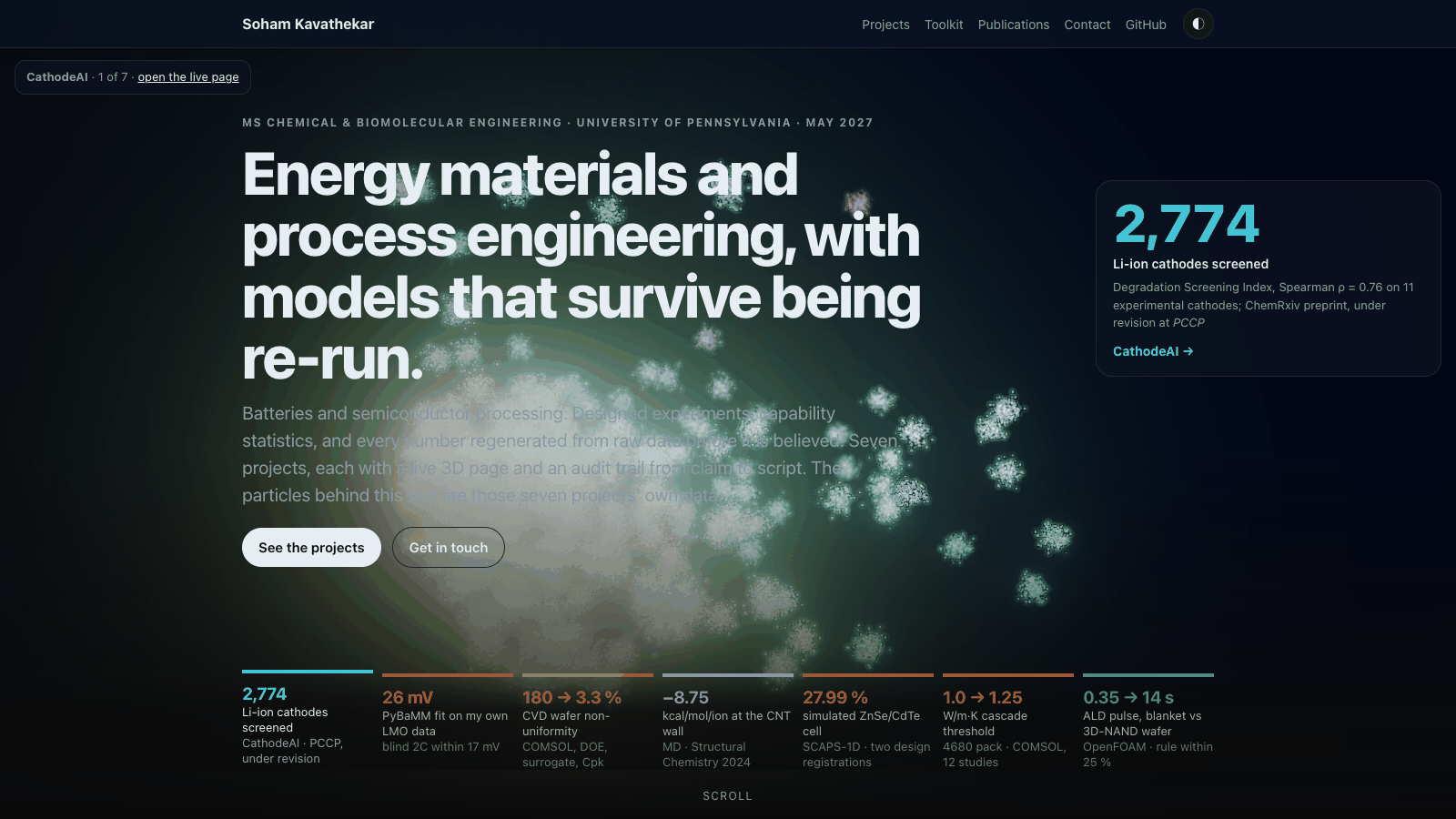
Energy materials and process engineering, with models that survive being re-run.
Batteries and semiconductor processing. Designed experiments, capability statistics, and every number regenerated from raw data before it is believed. Seven projects, each with a live 3D page and an audit trail from claim to script. The particles behind this text are those seven projects' own data.
2,774Li-ion cathodes screenedCathodeAI · PCCP, under revision
26 mVPyBaMM fit on my own LMO datablind 2C within 17 mV
180 → 3.3 %CVD wafer non-uniformityCOMSOL, DOE, surrogate, Cpk
−8.75kcal/mol/ion at the CNT wallMD · Structural Chemistry 2024
27.99 %simulated ZnSe/CdTe cellSCAPS-1D · two design registrations
1.0 → 1.25W/m·K cascade threshold4680 pack · COMSOL, 12 studies
0.35 → 14 sALD pulse, blanket vs 3D-NAND waferOpenFOAM · rule within 25 %
Scroll