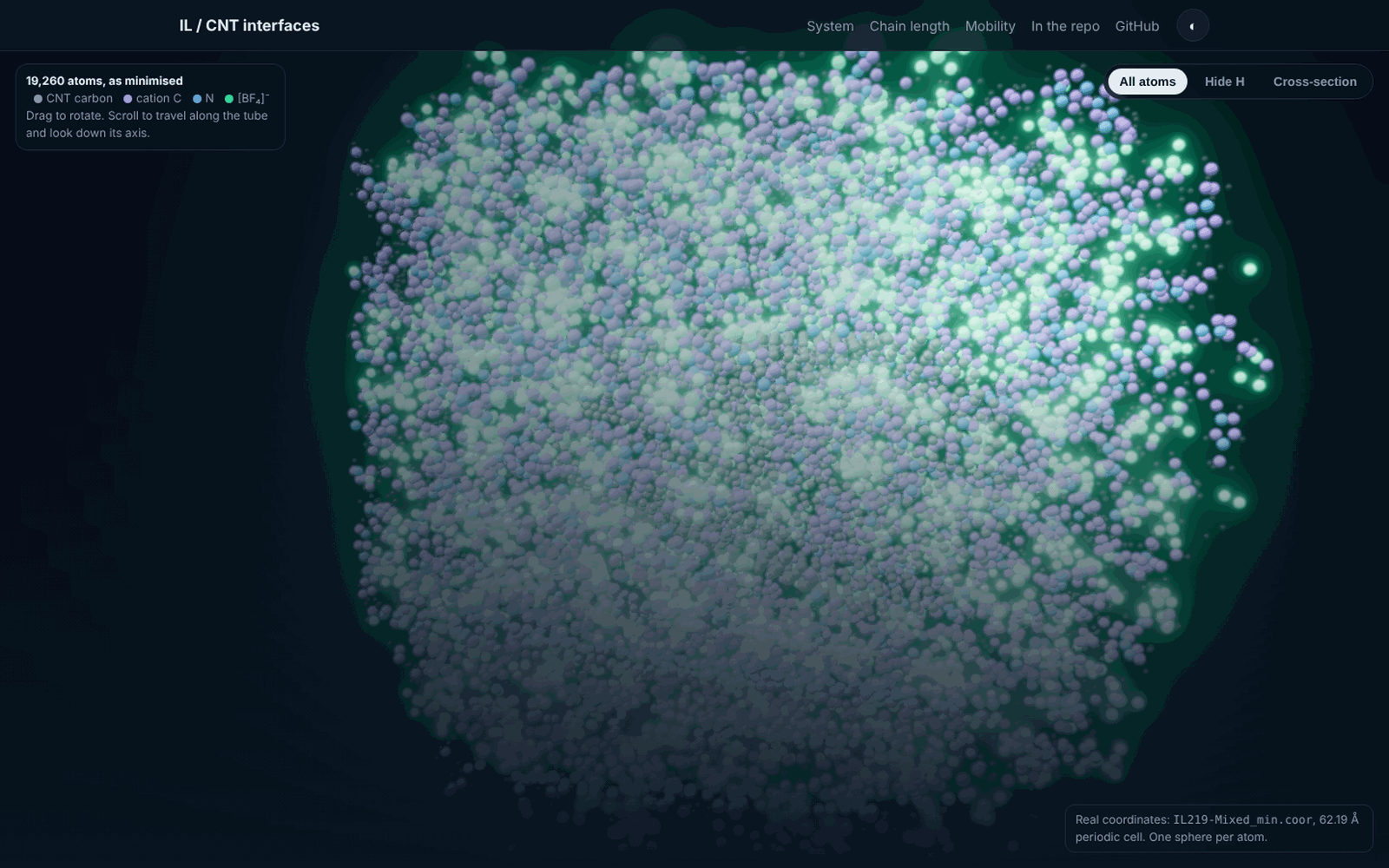
19,260 atoms, as minimised CNT carbon cation C N [BF₄]⁻ Drag to rotate. Scroll to travel along the tube and look down its axis.
The alkyl chain decides how an ionic liquid meets a nanotube.
All-atom molecular dynamics of four imidazolium [BF₄]⁻ ionic liquids, from [EMIM]⁺ to [OMIM]⁺, confined in a (15,15) carbon nanotube. Chain length sets how the cations orient at the wall, how strongly they bind and how fast they move. Published in Structural Chemistry (Springer Nature, 2024). The structure you are looking at is the minimised [BMIM][BF₄] system from this repository's NAMD files.
Real coordinates: IL219-Mixed_min.coor, 62.19 Å periodic cell. One sphere per atom.
Scroll
0
ionic liquids, one anion, chain lengths C2 to C8
0
ion pairs around a 1,260-atom (15,15) tube in each box
0ns
production per system, NPT 300 K, after annealing and 10 ns equilibration
0
atoms in the minimised structure shipped in this repository
01 · The system
One tube, one anion, four cations that differ only in chain length.
A (15,15) armchair single-walled nanotube, 50 Å long and 20 Å across, sits in a periodic box with 600 ion pairs of [EMIM][BF₄], [BMIM][BF₄], [HMIM][BF₄] or [OMIM][BF₄]. NAMD 2.14 with the OPLS-AA force field and CL&P ion parameters, particle-mesh Ewald electrostatics, a 1 fs step. Minimisation, five annealing cycles between 300 and 650 K, 5 + 5 ns of NPT equilibration, then 20 ns of production per system.
What the repository verifies
Value
From
Ions inside the tube, minimised structurecation ring Nanion B
Ion positions relative to the tube axis in the 19,260-atom minimised configuration, the starting structure of the published simulations. Hover a ribbon.
02 · Chain length published results
Longer chains lie down on the wall and bind harder. Shorter chains stand their ring against it and move faster.
The values below are reported in the article (Structural Chemistry 35, 1743–1753, 2024). The structures are the ion-pair coordinate files in this repository. Scroll through the four cations; the figure follows.
[EMIM][BF₄]1-ethyl-3-methylimidazolium · C2 chain
≈ −1.50kcal/mol per ion, interaction with the CNT
0.78H-bonds per cation in the tube
0.44D in CNT, ×10⁻¹⁰ m²/s
[EMIM]⁺, C2
The ring parks flat against the sidewall. Weakest binding of the series, fewest hydrogen bonds, fastest self-diffusion: the highest confined conductivity, 0.005 S/m.
[BMIM]⁺, C4
A butyl chain starts to compete with the ring for the wall. Binding roughly doubles relative to [EMIM]⁺. This is the system whose minimised structure is in the repository.
[HMIM]⁺, C6
The hexyl tail lies along the graphene-like wall and the ring tilts toward the axis, where anion contact and hydrogen bonding are more likely.
[OMIM]⁺, C8
Strongest interfacial binding, −8.75 kcal/mol per ion, and the most hydrogen bonds, about one per cation. Binding and mobility pull in opposite directions along the series: the design trade-off for CNT–IL electrolytes.
Ionic liquid
Chain
Dcation bulk (m²/s)
Dcation in CNT (m²/s)
H-bonds per cation
Eint with CNT (kcal/mol/ion)
Values as reported in the article (Structural Chemistry 35, 1743–1753, 2024); values marked ≈ are read from its interaction-energy figure.
Binding and hydrogen bonding against chain lengthvalues reported in the article
Both grow with chain length: the octyl tail stacks along the graphene-like wall and crowds the ring toward the axis, where anion contact is likelier. Hover a bar.
03 · Confinement published results
Inside the tube the cations slow down three- to four-fold.
Cation diffusion, bulk and confinedvalues reported in the article
Log axis. [EMIM]⁺ is fastest in both environments; every cation slows three- to four-fold inside the tube.
Mean-squared displacement of the cations drops by a factor of three to four on confinement for every chain length, with [EMIM]⁺ the fastest in both environments. Binding strength grows with chain length while mobility falls, so the best conductor of the series is the weakest binder.
At the walltubecation CN
Short chains park the imidazolium ring flat against the sidewall; long chains lay the alkyl tail along it. Drawn from the tube and ion-pair coordinates in the repository.
04 · What is in the repository
Structures, one complete NAMD minimisation and its log.
The CNT and the four ion-pair structures, the NAMD input for the minimisation of the [BMIM][BF₄] system, its 10,000-step energy log, the trajectory it wrote and the final 19,260-atom coordinates, which the hero renders atom for atom.
The minimisationtotalvan der Waalselectrostatic
10,000 steps from IL219-Mixed_min.log: the overlaps of the packed configuration relax within the first few hundred steps, the electrostatics over the rest.
git clone https://github.com/Soham-ChemE/MD-IL-CNT-Interfacial-Interactions.git
cd MD-IL-CNT-Interfacial-Interactions
pip install -r requirements.txt
./reproduce.sh          # rebuilds this page's data and figures from the NAMD files
vmd CNT.pdb IL219-Mixed_min.dcd   # inspect the minimisation trajectory
The Packmol-built configuration starts with large overlaps (van der Waals energy above 2 × 10⁶ kcal/mol) and relaxes within the first few hundred conjugate-gradient steps; the remaining 9,000 steps refine the electrostatics.
Cite
R. Biswas, P. Banerjee and S. S. Kavathekar, "Molecular dynamics studies on interfacial interactions between imidazolium-based ionic liquids and carbon nanotubes", Structural Chemistry 35, 1743–1753 (2024). doi 10.1007/s11224-024-02323-3. Process Simulation Research Group, School of Chemical Engineering, Vellore Institute of Technology.