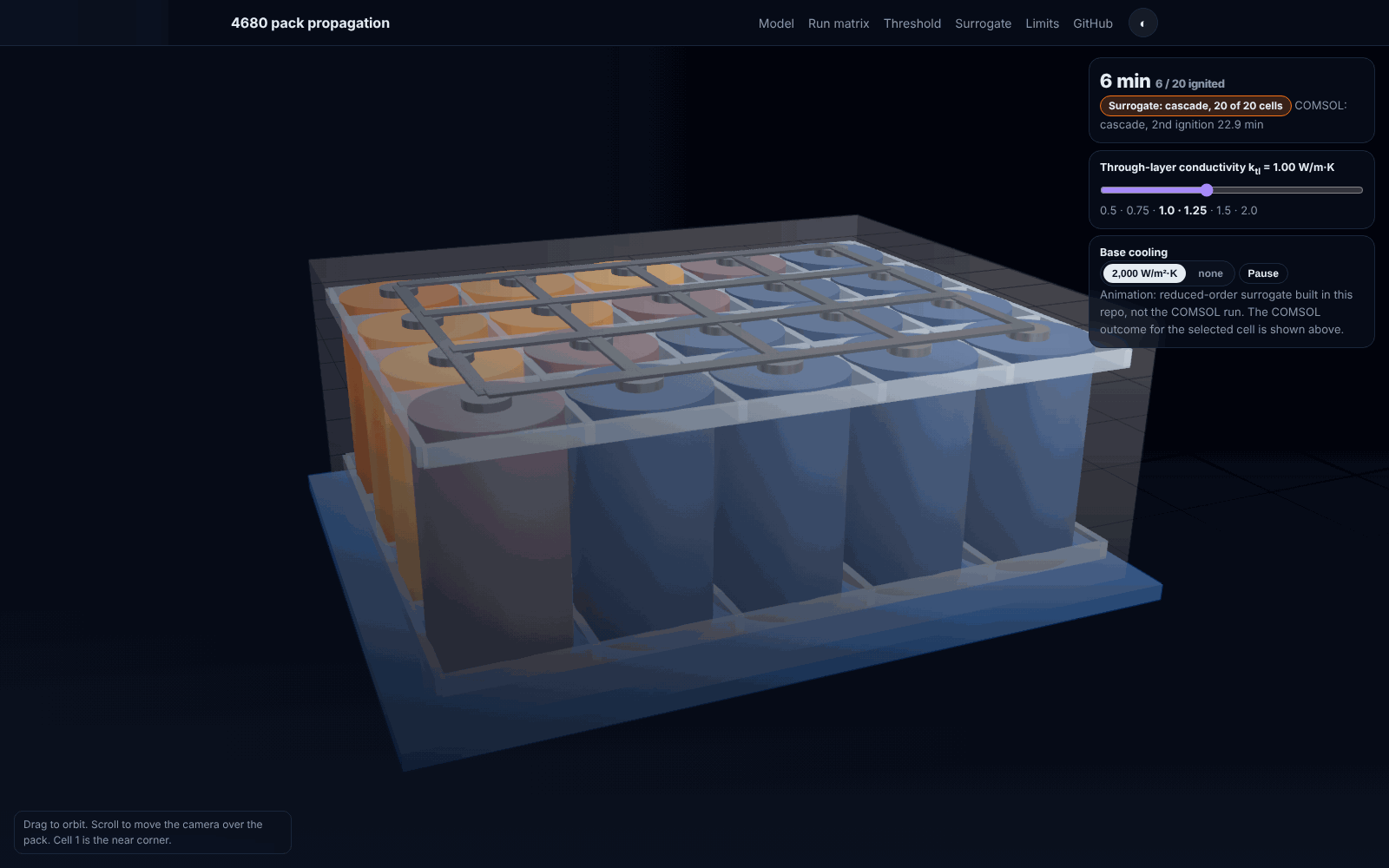
The animation plays the reduced-order model built in this repository; the COMSOL outcome for the selected cell is shown above.
Below 1.25 W/m·K across the windings, one failing cell takes most of the pack with it.
A 20-cell 4680 pack built in COMSOL Multiphysics 6.4 on the validated Application Library propagation model: 46 × 80 mm cells, 25 Ah, 110 kJ released per failing cell, one cell forced at one minute, neighbours triggered at 80 °C. Twelve one-hour studies located a sharp cascade threshold in through-layer (radial) conductivity between 1.0 and 1.25 W/m·K, showed that no base cooling from 100 to 2,000 W/m²·K moves it, and identified internal conduction, not the base contact, as the controlling resistance.
Drag to orbit. Scroll to move the camera over the pack. Cell 1 is the near corner.
Scroll
0
4680 cells, 5s4p, 2 mm gaps, acrylic holders, steel connectors
0
transient one-hour COMSOL studies across conductivity and cooling
0
mesh elements, 231 domains, about 2.7 GB
0kJ
runaway energy per cell, mass-scaled; 80 °C trigger for neighbours
01 · The question and the model
Which thermal resistance decides whether one cell's failure spreads through a 4680 pack?
The tabless 4680 is usually discussed electrically. The question here was thermal: in a pack of large cells, what controls propagation? The model is COMSOL's Thermal Runaway Propagation in a Battery Pack (Battery Design Module), built on Coman, Darcy and White (J. Electrochem. Soc. 169, 040516, 2022), adapted to 4680 geometry, capacity and runaway energy. Scroll to assemble the pack.
The 20-cell pack, explodedcooled basecellsbusbars, holders
Drag to orbit. Every dimension comes from results/matrix.json: 46 × 80 mm cells at 48 mm pitch, two acrylic frames, steel AISI 4340 strips, a cooled floor with heff = 1/(1/hplate + Rcap).
Item
Value
The swept parameter, stated preciselyIn COMSOL's spirally wound Battery Layers node, kT_batt_tl is the through-layer conductivity: across the windings, the radial direction of a cylindrical cell, stock 1 W/m·K. kT_batt_il, along the foils (azimuthal and axial, stock 30 W/m·K), was held fixed. The sweep varied the through-layer value; tabless construction itself changes how the foil edges meet the cap, which is a separate lever.
02 · The run matrix COMSOL
Twelve one-hour studies. One sharp line between cascade and arrest.
Rows are base cooling hplate, columns are through-layer conductivity ktl. Scroll through the four phases; the tile field lifts the runs each phase added.
Phase 1 · contact resistanceh = 2,000, k = 1.0
Phase 1 · Cap contact resistance
Tabbed Rcap = 10⁻³ against tabless 10⁻⁵ m²·K/W on the pack floor with hplate = 2,000. Second ignition 22.6 against 22.9 min: a 100× change in the base contact moved onset by about 20 s out of 23 min. Diagnosis: the acrylic floor's own resistance is larger than the contact's, so the base contact is not the controlling resistance. The study moved to internal conduction.
Phase 2 · Through-layer sweep
At hplate = 2,000: ktl = 1.0 cascaded (second ignition 22.9 min, about 13 further cells by 52 min). 1.25, 1.5 and 2.0 stopped at cell 1. A 25 % change in internal conductivity flipped the outcome.
Phase 3 · Is it a cooling artefact?
At hplate = 500 the threshold did not move: 1.0 cascaded at 22.4 min, 1.25 and 1.5 stopped. With Bi ≈ 11 to 46 the inside of the cell, not the plate, is the bottleneck.
Phase 4 · Adiabatic stress test
At the threshold value 1.25: with no cooling at all the pack cascaded (second ignition about 26.9 min, pack average about 260 °C at the end); h = 100 arrested. Near the threshold a cell needs both an internal conduction path and a heat sink.
hplate (W/m²·K)
ktl = 1.0
1.25
1.5
2.0
Rcap = 10⁻⁵ m²·K/W, 110 kJ per cell, 25 Ah. Hover a tile for the run. † inferred from the neighbouring runs.
03 · Why the threshold exists, and the numbers that check it
A neighbour triggers on its hottest point, and that point is the skin facing the burning cell.
With low through-layer conductivity, arriving heat piles up at that skin and the local maximum crosses 80 °C. With higher conductivity it spreads inward and down to the cooled base, and the maximum stays below 80 °C. The step trigger makes the transition sharp, the same tipping behaviour as a thermal-explosion threshold.
Threshold locatedCascade at ktl = 1.0, arrest at 1.25 W/m·K, at both h = 500 and h = 2,000. Below it about 13 of 20 cells fail within the hour; above it the failure stays at cell 1.
Adiabatic stress testAt 1.25 W/m·K, removing the heat sink entirely brings the cascade back; h = 100 is already enough to arrest it. Between 100 and 2,000 W/m²·K the threshold never moved.
Controlling resistance identifiedA 100× change in base contact resistance moved onset by 20 s in 23 min: the acrylic floor and the cell interior, not the cap contact, set the pace. That diagnosis redirected the study and is the engineering result.
The mechanismburning cellneighbour
The neighbour's facing skin is where its maximum temperature sits. Heat reaches it through 2 mm of air, the acrylic bridge and the steel strip; whether it crosses 80 °C depends on how fast the cell conducts the heat inward and down to the base.
Check (analysis/scaling.py)
Value
Each line is one physical estimate from the notes, recomputed and tested in the repository. The pulse is spread over the whole homogenised cell, so the energy balance is exact and the peak is the uniform-cell value; real cells localise the heat and run hotter.
Adiabatic peak against runaway energyΔT = W / m·cₚ
110 kJ into 0.266 kg at 1,400 J/kg·K gives ΔT ≈ 295 K, about 325 °C: inside the 280 to 340 °C band of peaks seen in the runs. Hover the ribbon.
Diffusion times and Biot numbers4680 radial2170 radial4680 axial
R²/α with k = 1 W/m·K: about 25 min for a 4680 against 5 min for a 2170, five times slower radial heat removal. Bi well above 1 at every cooling value used: internal conduction limits heat removal before the plate does.
04 · Reduced-order model built here
A thermal network simple enough to read in one sitting reproduces the threshold and the adiabatic flip.
Each cell is a core plus five radial shells split into 16 sectors; radial links use ktl, azimuthal links use kil. Neighbours couple through still air, acrylic holder bridges and steel strips; the cells sit in a wrapped air compartment; base cooling acts on each footprint through the axial path, a 3 mm acrylic floor and 1/heff. Same 110 kJ pulse, same 80 °C maximum-temperature trigger, 0.1 s explicit steps for 60 min. The inter-cell coupling is calibrated once, at h = 2,000; the model then agrees with the COMSOL threshold at h = 500 and 2,000, reproduces the adiabatic flip at k = 1.25, and confirms that base contact resistance is second-order. The hero animation plays its traces.
Twenty cells, one hour
Per-cell maximum temperature from the reduced-order model at h = 2,000. Hover a ribbon for its ignition time.
The reduced-order sweepcascadearrested
Six conductivities by four cooling values, 24 runs of about a second each. Hover a tile for the cell count and the neighbour's peak.
Question
COMSOL
Reduced-order model
Scope: the reduced-order model is a reading aid for the finite-element result. Its absolute threshold position depends on the inter-cell conductances it was calibrated with; the trends and the mechanism are what it is for.
Sources: COMSOL Application Library 107571 and its 6.4 documentation page; Coman, Darcy and White, J. Electrochem. Soc. 169, 040516 (2022); the author's project notes.